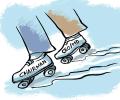
Profitability and cash reserves have halved since the global financial crisis.

The combined market capitalisation of the top 873 family-owned companies was down 26.3 per cent year-on-year (YoY) to Rs 61.8 trillion at the end of trading on Tuesday. It had grown 6 per cent in FY19 and nearly 20 per cent in FY18.
Some of the top indebted companies likely to face financial headwinds in the coming quarters include NTPC, PowerGrid, Tata Steel, Adani Power, JSW Steel, UPL, and Steel Authority of India. Together these 201 companies owed Rs 14.9 trillion to their lenders at the end of September 30, 2019, up 4.1 per cent year-on-year (YoY) during the first half of FY20.

In the manufacturing sector, output is expected to decline by about 70 per cent as only food-processing, and drugs and pharma industries are allowed to operate while other segments, such as engineering and metals, have shut operations.

Vodafone Idea's net worth (or shareholders' equity) was down 73 per cent year-on-year to around Rs 17,600 crore at the end of the December 2019 quarter after the company reported a net loss of around Rs 6,400 crore during the quarter. Cumulatively, the company has lost nearly Rs 45,000 crore in the last four quarters, eroding its net worth to its lowest level in three-year. Analysts said a such a low level of net worth, coupled with continuing losses in operations, ruled out the possibility of the company getting fresh loans from lenders to fund its adjusted gross revenue (AGR) dues of Rs 54,000 crore.

The Indian rupee is down nearly 2 per cent against the US dollar since the beginning of January 2019. Experts attribute the Indian rupee's relatively poor performance to a sharper-than-expected fall in economic growth in India.

The country's top FMCG stocks, such as Hindustan Unilever, ITC, Nestl, Britannia, Godrej Consumer Products, and Dabur, among others, are currently trading at around 41x their trailing 12-month earnings, down from their peak P/E multiple of around 48x at the end of December 2018.

A Molotov cocktail of lies, abuse and bigotry is blowing up social media.

This is the biggest equity-raising exercise by an Indian corporate within a financial year. The fundraising - led by Citibank, Goldman, Kotak and Axis Capital as bankers - will see participation by foreign and domestic institutional investors.

Richest 10 account for 41% of promoter wealth, up from 33% in December 2018, says Krishna Kant.

The Sensex is on course to ending calendar year (CY) 2019 at a price-earnings (P/E) multiple of 29x, the highest in 25 years. Current valuations are, however, lower than those seen in the early 1990s. The Sensex has risen close to 14 per cent in the last 12 months, while the index underlying EPS dropped 6.7 per cent during the period.

The biggest fear many of the e-commerce firms have is the possible requirement to change business models overnight, which would drastically increase costs as well as disrupt businesses.
The company has a valuation of Rs 2.22 trillion, up from Rs 1.33 trillion a year ago.

Collapse of the mobile operator could translate into total loss of nearly Rs 44,000 crore for the AV Birla group.
It reported adding 698,3146 subscribers in September, the lowest since it added 6.1 million in November 2017.

Video isn't just about old school television shows, advertisements and tutorials anymore - short, crisp and engaging content across different formats is becoming increasingly popular in a world where stories are consumed on the go.

Campus recruits can also aim to double the existing entry level package by proving their skills through the TCS national qualifier tests.

Active subscriber base declined by 2.2 million on a month-on-month (MoM) basis to 970.2 million in August 2019, on the back of Bharti Airtel and Vodafone Idea losing customers. Jio was the only operator to add 7.2 million active subscribers in the same month.

After the latest spike in crude oil prices, petrol prices could potentially go up to around Rs 90 a litre making a dent in the consumer's wallet. This, the analysts fear, will push the cost of vehicle ownership in the country, further reducing the demand potential for the industry.
In Friday's market rally post the corporate tax cut, the country's top business promoters recouped more than two-thirds of the losses that they suffered in the post-Budget sell-off in equity markets.
 © 2025 Rediff.com - Investor Information - Advertise with us - Disclaimer - Privacy Policy - Sitemap - Feedback - About us - Terms of use - Grievances